What Is Piet Mondrian Art Tools Called What Kind of Art Tools Did Piet Mondrian Use
| Piet Mondrian | |
|---|---|
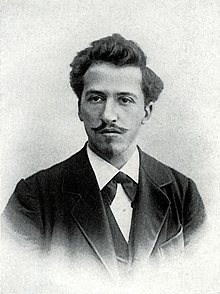 After 1906 | |
| Born | Pieter Cornelis Mondriaan (1872-03-07)seven March 1872 Amersfoort, Netherlands |
| Died | 1 February 1944(1944-02-01) (aged 71) New York City, U.S. |
| Educational activity | Rijksakademie van beeldende kunsten |
| Known for | Painting |
| Notable work | Evening; Red Tree, Gray Tree, Limerick with Reddish Blue and Yellow, Broadway Boogie Woogie, Victory Boogie Woogie |
| Movement | De Stijl, abstract art |
Pieter Cornelis Mondriaan (Dutch: [ˈpitər kɔrˈneːlɪs ˈmɔndrijaːn]), after 1906 Piet Mondrian (, also , Dutch: [pit ˈmɔndrijɑn]; 7 March 1872 – one February 1944), was a Dutch painter and fine art theoretician who is regarded as one of the greatest artists of the 20th century. He is known for existence one of the pioneers of 20th-century abstract art, as he changed his artistic direction from figurative painting to an increasingly abstract manner, until he reached a point where his artistic vocabulary was reduced to simple geometric elements.
Mondrian's art was highly utopian and was concerned with a search for universal values and aesthetics. He proclaimed in 1914: "Art is higher than reality and has no direct relation to reality. To arroyo the spiritual in art, one will make equally little utilise every bit possible of reality, because reality is opposed to the spiritual. We observe ourselves in the presence of an abstruse art. Art should be above reality, otherwise information technology would have no value for human." His fine art, however, always remained rooted in nature.
He was a correspondent to the De Stijl fine art movement and group, which he co-founded with Theo van Doesburg. He evolved a non-representational form which he termed Neoplasticism. This was the new 'pure plastic fine art' which he believed was necessary in gild to create 'universal beauty'. To express this, Mondrian eventually decided to limit his formal vocabulary to the 3 primary colors (red, blueish and yellow), the 3 primary values (black, white and grayness) and the ii main directions (horizontal and vertical). Mondrian's arrival in Paris from kingdom of the netherlands in 1911 marked the beginning of a period of profound change. He encountered experiments in Cubism and with the intent of integrating himself inside the Parisian avant-garde removed an 'a' from the Dutch spelling of his proper name (Mondriaan).
Mondrian'southward work had an enormous influence on 20th century art, influencing non simply the course of abstract painting and numerous major styles and art movements (east.g. Color Field painting, Abstract Expressionism and Minimalism), only likewise fields outside the domain of painting, such as design, architecture and fashion. Design historian Stephen Bayley said: "Mondrian has come to mean Modernism. His name and his work sum up the High Modernist platonic. I don't like the word 'iconic', so let's say that he's become totemic – a totem for everything Modernism set out to exist."
Life [edit]
Netherlands (1872–1911) [edit]
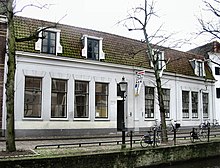

Piet Mondrian lived in this house, now the Villa Mondriaan, in Winterswijk, from 1880 to 1892.
Mondrian was built-in in Amersfoort, province of Utrecht in the netherlands, the second of his parents' children.[one] He was descended from Christian Dirkzoon Monderyan who lived in The Hague as early on as 1670.[2] The family moved to Winterswijk when his begetter, Pieter Cornelius Mondrian, was appointed caput instructor at a local principal school.[iii] Mondrian was introduced to art from an early age. His father was a qualified cartoon teacher, and, with his uncle, Fritz Mondrian (a pupil of Willem Maris of the Hague School of artists), the younger Piet often painted and drew along the river Gein.[4]
After a strict Protestant upbringing, in 1892, Mondrian entered the Academy for Fine Fine art in Amsterdam.[5] He was already qualified as a teacher.[3] He began his career as a instructor in primary instruction, only he besides skilful painting. Most of his work from this period is naturalistic or Impressionistic, consisting largely of landscapes. These pastoral images of his native state draw windmills, fields, and rivers, initially in the Dutch Impressionist manner of the Hague Schoolhouse and and then in a variety of styles and techniques that attest to his search for a personal manner. These paintings are representational, and they illustrate the influence that various artistic movements had on Mondrian, including pointillism and the vivid colors of Fauvism.

Willow Grove: Impression of Calorie-free and Shadow, c. 1905, oil on sheet, 35 × 45 cm, Dallas Museum of Art


Bound Sun (Lentezon): Castle Ruin: Brederode, c. late 1909 – early 1910, oil on masonite, 62 × 72 cm, Dallas Museum of Art
On display in the Gemeentemuseum Den Haag are a number of paintings from this period, including such Post-Impressionist works equally The Red Manufacturing plant and Trees in Moonrise. Another painting, Evening (Avond) (1908), depicting a tree in a field at dusk, even augurs future developments by using a palette consisting almost entirely of red, yellow, and blue. Although Avond is simply limitedly abstract, information technology is the primeval Mondrian painting to emphasize primary colors.
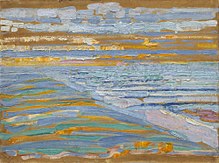
Piet Mondrian, View from the Dunes with Beach and Piers, Domburg, 1909, oil and pencil on cardboard, Museum of Modern Fine art, New York
Mondrian'southward earliest paintings showing a degree of abstraction are a series of canvases from 1905 to 1908 that describe dim scenes of indistinct trees and houses reflected in still water. Although the result leads the viewer to begin focusing on the forms over the content, these paintings are notwithstanding firmly rooted in nature, and it is simply the knowledge of Mondrian'south later achievements that leads i to search in these works for the roots of his future abstraction.
Mondrian's art was intimately related to his spiritual and philosophical studies. In 1908, he became interested in the theosophical movement launched by Helena Petrovna Blavatsky in the late 19th century, and in 1909 he joined the Dutch co-operative of the Theosophical Gild. The work of Blavatsky and a parallel spiritual movement, Rudolf Steiner'southward Anthroposophy, significantly affected the further evolution of his aesthetic.[6] Blavatsky believed that it was possible to attain a more profound knowledge of nature than that provided by empirical means, and much of Mondrian's work for the remainder of his life was inspired past his search for that spiritual knowledge. In 1918, he wrote "I got everything from the Underground Doctrine", referring to a book written by Blavatsky. In 1921, in a letter to Steiner, Mondrian argued that his neoplasticism was "the fine art of the foreseeable time to come for all true Anthroposophists and Theosophists". He remained a committed Theosophist in subsequent years, although he too believed that his own artistic current, neoplasticism, would eventually become office of a larger, ecumenical spirituality.[vii]
Mondrian and his later on work were deeply influenced by the 1911 Moderne Kunstkring exhibition of Cubism in Amsterdam. His search for simplification is shown in two versions of Even so Life with Ginger Pot (Stilleven met Gemberpot). The 1911 version,[8] is Cubist; in the 1912 version,[ix] the objects are reduced to a round shape with triangles and rectangles.
Paris (1911–1914) [edit]
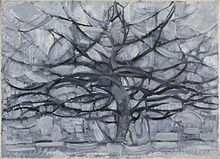
In 1911, Mondrian moved to Paris and changed his name, dropping an "a" from "Mondriaan", to emphasize his divergence from kingdom of the netherlands, and his integration within the Parisian advanced.[eleven] [12] While in Paris, the influence of the Cubist style of Pablo Picasso and Georges Braque appeared nigh immediately in Mondrian's work.[xiii] Paintings such every bit The Sea (1912) and his various studies of trees from that year yet incorporate a measure of representation, simply, increasingly, they are dominated by geometric shapes and interlocking planes. While Mondrian was eager to absorb the Cubist influence into his work, information technology seems clear that he saw Cubism equally a "port of telephone call" on his artistic journeying, rather than as a destination.
Netherlands (1914–1918) [edit]
Unlike the Cubists, Mondrian notwithstanding attempted to reconcile his painting with his spiritual pursuits, and in 1913 he began to fuse his art and his theosophical studies into a theory that signaled his final suspension from representational painting. While Mondrian was visiting the Netherlands in 1914, Earth War I began, forcing him to remain there for the duration of the conflict. During this period, he stayed at the Laren artists' colony, where he met Bart van der Leck and Theo van Doesburg, who were both undergoing their ain personal journeys toward abstraction. Van der Leck'due south employ of only primary colors in his art greatly influenced Mondrian. Subsequently a meeting with Van der Leck in 1916, Mondrian wrote, "My technique which was more or less Cubist, and therefore more or less pictorial, came under the influence of his precise method."[fourteen] With Van Doesburg, Mondrian founded De Stijl (The Style), a periodical of the De Stijl Group, in which he first published essays defining his theory, which he called neoplasticism.
Mondrian published "De Nieuwe Beelding in de schilderkunst" ("The New Plastic in Painting"),[15] in twelve installments during 1917 and 1918. This was his first major attempt to express his artistic theory in writing. Mondrian's best and most-often quoted expression of this theory, all the same, comes from a letter he wrote to H. P. Bremmer in 1914:
I construct lines and color combinations on a flat surface, in order to express full general dazzler with the utmost sensation. Nature (or, that which I come across) inspires me, puts me, as with any painter, in an emotional state so that an urge comes almost to make something, but I desire to come as close as possible to the truth and abstract everything from that, until I reach the foundation (still only an external foundation!) of things… I believe it is possible that, through horizontal and vertical lines synthetic with awareness, only not with calculation, led by loftier intuition, and brought to harmony and rhythm, these basic forms of beauty, supplemented if necessary by other direct lines or curves, can go a piece of work of art, every bit strong every bit it is true.[16]
Over the adjacent two decades, Mondrian methodically developed his signature fashion embracing the Classical, Platonic, Euclidean worldview where he only focused on his, now iconic, horizontal and vertical black lines forming squares and rectangles filled with master hues.[17]
Paris (1918–1938) [edit]

Piet Mondrian and Pétro (Nelly) van Doesburg in Mondrian's Paris studio, 1923
When World State of war I ended in 1918, Mondrian returned to French republic, where he would remain until 1938. Immersed in postal service-state of war Paris culture of creative innovation, he flourished and fully embraced the art of pure abstraction for the rest of his life. Mondrian began producing grid-based paintings in belatedly 1919, and in 1920, the style for which he came to exist renowned began to appear.
In the early on paintings of this style, the lines delineating the rectangular forms are relatively sparse, and they are gray, non black. The lines also tend to fade equally they approach the edge of the painting, rather than stopping abruptly. The forms themselves, smaller and more numerous than in after paintings, are filled with principal colors, blackness, or gray, and nearly all of them are colored; only a few are left white.
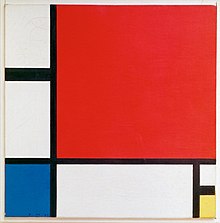
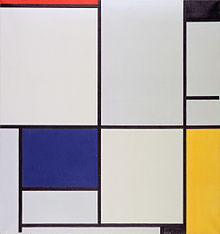
During late 1920 and 1921, Mondrian'southward paintings arrive at what is to casual observers their definitive and mature class. Thick black lines now separate the forms, which are larger and fewer in number, and more than of the forms are left white. This was not the culmination of his artistic evolution, however. Although the refinements became subtler, Mondrian's piece of work continued to evolve during his years in Paris.
In the 1921 paintings, many, though not all, of the black lines finish brusque at a seemingly capricious distance from the edge of the canvas, although the divisions between the rectangular forms remain intact. Here, also, the rectangular forms remain generally colored. As the years passed and Mondrian'southward work evolved further, he began extending all of the lines to the edges of the canvas, and he began to utilize fewer and fewer colored forms, favoring white instead.
These tendencies are peculiarly obvious in the "lozenge" works that Mondrian began producing with regularity in the mid-1920s. The "lozenge" paintings are square canvases tilted 45 degrees, then that they accept a diamond shape. Typical of these is Schilderij No. ane: Lozenge With Two Lines and Blue (1926). 1 of the almost minimal of Mondrian'south canvases, this painting consists only of two black, perpendicular lines and a small blueish triangular form. The lines extend all the way to the edges of the sail, almost giving the impression that the painting is a fragment of a larger work.
Although i'southward view of the painting is hampered by the drinking glass protecting it, and by the toll that age and treatment have plain taken on the canvas, a close examination of this painting begins to reveal something of the artist'south method. The painting is not composed of perfectly flat planes of color, as one might expect. Subtle brush strokes are evident throughout. The artist appears to have used different techniques for the various elements.[18] The black lines are the flattest elements, with the least amount of depth. The colored forms have the most obvious brush strokes, all running in i direction. Almost interesting, withal, are the white forms, which clearly have been painted in layers, using brush strokes running in different directions. This generates a greater sense of depth in the white forms then that they appear to overwhelm the lines and the colors, which indeed they were doing, every bit Mondrian's paintings of this menses came to be increasingly dominated past white space.
In 1926, Katherine Dreier, co-founder of New York City's Lodge of Independent Artists (forth with Marcel Duchamp and Man Ray), visited Piet Mondrian's studio in Paris and acquired 1 of his diamond compositions, Painting I. This was then shown during an exhibition organized past the Society of Independent Artists in the Brooklyn Museum--the showtime major exhibition of modern art in America since the Armory Bear witness. She stated in the catalog that "Holland has produced three great painters who, though a logical expression of their own country, rose in a higher place it through the vigor of their personality – the offset was Rembrandt, the second was Van Gogh, and the tertiary is Mondrian."[xix]
As the years progressed, lines began to take precedence over forms in Mondrian's paintings. In the 1930s, he began to use thinner lines and double lines more than often, punctuated with a few small colored forms, if any at all. Double lines particularly excited Mondrian, for he believed they offered his paintings a new dynamism which he was eager to explore. The introduction of the double line in his work was influenced by the work of his friend and gimmicky Marlow Moss.[xx] [ page needed ]
From 1934 to 1935, three of Mondrian's paintings were exhibited as function of the "Abstract and Concrete" exhibitions in the UK at Oxford, London, and Liverpool.[21]
London and New York (1938–1944) [edit]

In September 1938, Mondrian left Paris in the confront of advancing fascism and moved to London. After kingdom of the netherlands was invaded and Paris cruel in 1940, he left London for Manhattan in New York City, where he would remain until his death. Some of Mondrian'south after works are difficult to identify in terms of his artistic development considering there were quite a few canvases that he began in Paris or London and only completed months or years later on in Manhattan. The finished works from this later on period are visually decorated, with more lines than any of his work since the 1920s, placed in an overlapping organisation that is almost cartographical in appearance. He spent many long hours painting on his own until his hands blistered, and he sometimes cried or made himself sick.
Mondrian produced Lozenge Composition With 4 Yellowish Lines (1933), a simple painting that innovated thick, colored lines instead of blackness ones. After that one painting, this practise remained dormant in Mondrian's work until he arrived in Manhattan, at which time he began to embrace it with carelessness. In some examples of this new direction, such as Composition (1938) / Place de la Concorde (1943), he appears to have taken unfinished black-line paintings from Paris and completed them in New York past adding short perpendicular lines of different colors, running betwixt the longer black lines, or from a black line to the edge of the canvas. The newly colored areas are thick, well-nigh bridging the gap between lines and forms, and it is startling to run across color in a Mondrian painting that is unbounded by blackness. Other works mix long lines of red amidst the familiar black lines, creating a new sense of depth past the improver of a colored layer on acme of the black one. His painting Limerick No. 10, 1939–1942, characterized past principal colors, white footing and black filigree lines clearly divers Mondrian's radical just classical approach to the rectangle.

On 23 September 1940 Mondrian left Europe for New York aboard the Cunard White Star Line send RMSSamaria(1920), departing from Liverpool.[23] The new canvases that Mondrian began in Manhattan are even more startling, and indicate the beginning of a new idiom that was cutting brusk by the artist'due south death. New York City (1942) is a complex lattice of ruby-red, blue, and yellow lines, occasionally interlacing to create a greater sense of depth than his previous works.[24] An unfinished 1941 version of this work uses strips of painted newspaper tape, which the artist could rearrange at will to experiment with different designs.

His painting Broadway Boogie-Woogie (1942–43) at The Museum of Mod Fine art in Manhattan was highly influential in the schoolhouse of abstract geometric painting. The piece is made up of a number of shimmering squares of brilliant color that spring from the canvas, then appear to shimmer, drawing the viewer into those neon lights. In this painting and the unfinished Victory Boogie Woogie (1942–1944), Mondrian replaced onetime solid lines with lines created from small-scale adjoining rectangles of color, created in part by using small pieces of paper tape in various colors. Larger unbounded rectangles of color punctuate the pattern, some with smaller concentric rectangles inside them. While Mondrian's works of the 1920s and 1930s tend to take an almost scientific austerity almost them, these are bright, lively paintings, reflecting the upbeat music that inspired them and the city in which they were made.
In these final works, the forms take indeed usurped the role of the lines, opening another new door for Mondrian's development as an abstractionist. The Boogie-Woogie paintings were clearly more of a revolutionary change than an evolutionary one, representing the most profound development in Mondrian's work since his abandonment of representational fine art in 1913.
In 2008 the Dutch tv set program Andere Tijden constitute the only known movie footage with Mondrian.[25] The discovery of the film footage was appear at the cease of a two-year research plan on the Victory Boogie Woogie. The inquiry institute that the painting was in very practiced condition and that Mondrian painted the limerick in one session. It too was found that the limerick was changed radically by Mondrian soon before his decease by using pocket-size pieces of colored tape.
Wall works [edit]
When the 47-year-erstwhile Piet Mondrian left the Netherlands for unfettered Paris for the 2nd and terminal time in 1919, he set near at one time to brand his studio a nurturing environment for paintings he had in mind that would increasingly limited the principles of neoplasticism most which he had been writing for ii years. To hide the studio'due south structural flaws apace and inexpensively, he tacked upwardly large rectangular placards, each in a single color or neutral hue. Smaller colored paper squares and rectangles, composed together, accented the walls. So came an intense period of painting. Again he addressed the walls, repositioning the colored cutouts, adding to their number, altering the dynamics of color and infinite, producing new tensions and equilibrium. Before long, he had established a creative schedule in which a menses of painting took turns with a period of experimentally regrouping the smaller papers on the walls, a process that directly fed the side by side flow of painting. It was a pattern he followed for the rest of his life, through wartime moves from Paris to London's Hampstead in 1938 and 1940, beyond the Atlantic to Manhattan.
At the age of 71 in the fall of 1943, Mondrian moved into his second and concluding Manhattan studio at 15 Due east 59th Street, and set virtually to recreate the environment he had learned over the years was most congenial to his modest way of life and most stimulating to his fine art. He painted the loftier walls the aforementioned off-white he used on his easel and on the seats, tables and storage cases he designed and fashioned meticulously from discarded orange and apple-crates. He glossed the height of a white metal stool in the same brilliant primary red he applied to the cardboard sheath he fabricated for the radio-phonograph that spilled along his beloved jazz from well-traveled records. Visitors to this terminal studio seldom saw more than than one or 2 new canvases, only found, oftentimes to their astonishment, that 8 large compositions of colored bits of paper he had tacked and re-tacked to the walls in ever-irresolute relationships constituted together an environment that, paradoxically and simultaneously, was both kinetic and serene, stimulating and restful. It was the best infinite, Mondrian said, that he had inhabited. He was there for only a few months, as he died in February 1944.
After his death, Mondrian's friend and sponsor in Manhattan, creative person Harry Holtzman, and another painter friend, Fritz Glarner, advisedly documented the studio on motion-picture show and in still photographs before opening information technology to the public for a six-week exhibition. Before dismantling the studio, Holtzman (who was as well Mondrian'due south heir) traced the wall compositions precisely, prepared exact portable facsimiles of the space each had occupied, and affixed to each the original surviving cut-out components. These portable Mondrian compositions have become known as "The Wall Works". Since Mondrian'south decease, they take been exhibited twice at Manhattan's Museum of Modern Fine art (1983 and 1995–96),[26] once in SoHo at the Carpenter + Hochman Gallery (1984), once each at the Galerie Tokoro in Tokyo, Japan (1993), the XXII Biennial of Sao Paulo (1994), the University of Michigan (1995), and – the first time shown in Europe – at the Akademie der Künste (Academy of The Arts), in Berlin (22 February – 22 April 2007). His piece of work was too shown in a retrospective exhibition at the Whitechapel Gallery in London, which ran from August – September 1955.
Decease and legacy [edit]
Piet Mondrian died of pneumonia on one February 1944 and was interred at the Cypress Hills Cemetery in Brooklyn, New York.[27]
On 3 February 1944 a memorial was held for Mondrian at the Universal Chapel on Lexington Artery and 52nd Street in Manhattan. The service was attended by about 200 people including Alexander Archipenko, Marc Chagall, Marcel Duchamp, Fernand Léger, Alexander Calder and Robert Motherwell.[28]
The Mondrian / Holtzman Trust functions as Mondrian's official estate, and "aims to promote awareness of Mondrian'due south artwork and to ensure the integrity of his piece of work".[29]
Mondrian has been described by critic Robert Hughes, in his 1980 book The Daze of the New, as "one of the supreme artists of the 20th century."[30] Likewise in his boob tube documentaries of The Stupor of the New, Hughes referred to Mondrian every bit "one of the greatest artists of the 20th century (...) who was i of the last painters who believed that the conditions of homo life could be changed by making pictures".[31] Dutch art historian Carel Blotkamp, who is considered an authority on De Stijl, has described Mondrian every bit "one of the great artists of the twentieth century".[32]
Claims for Nazi looted art [edit]
In Oct 2020, Mondrian'due south heirs filed a lawsuit in a U.S. courtroom against the Kaiser Wilhelm Museum in Krefeld, Federal republic of germany for the render of four paintings past Mondrian.[33]
In December 2021, Mondrian's heirs sued the Philadelphia Museum of Art for the render of Mondrian's Limerick with Blueish (1928) which had been seized by the Nazis, and passed through the art dealers Karl Buchholz and Curt Valentin before being gifted to the museum by Albert Eastward. Gallatin.[34] [35] [36]
References in civilization [edit]

- The National Museum of Serbia was the starting time museum to include one of Mondrian's paintings in its permanent exhibition.[37]
- Along with Klee and Kandinsky, Mondrian was one of the main inspirations to the early pointillist musical aesthetic of serialist composer Pierre Boulez,[38] [ page needed ] although his interest in Mondrian was restricted to the works of 1914–xv.[39] [ page needed ] By May 1949 Boulez said he was "suspicious of Mondrian," and by Dec 1951 expressed a dislike for his paintings (regarding them as "the virtually denuded of mystery that take always been in the earth"), and a strong preference for Klee.[40]
- In the 1930s, the French fashion designer Lola Prusac, who worked at that time for Hermès in Paris, designed a range of luggage and bags inspired past the latest works of Mondrian: inlays of red, blue, and yellow leather squares.[41]
- Style designer Yves Saint Laurent's Autumn 1965 Mondrian collection featured shift dresses in blocks of primary color with blackness adjoining, inspired past Mondrian.[42] The collection proved so popular that it inspired a range of imitations that encompassed garments from coats to boots.
- The 1970–1974 American idiot box serial The Partridge Family featured a musical family who purchase an (already-erstwhile at the fourth dimension) 1957 Chevrolet Superior Omnibus Series 6800 schoolhouse passenger vehicle for employ as their tour bus, and so repaint it in a colored geometric pattern heavily inspired by Mondrian's grid-based paintings. The reason for this choice of pattern is never discussed in the TV series.
- The La Vie Claire cycling squad's bicycles and vesture designs were inspired by Mondrian'south work throughout the 1980s. The French ski and cycle equipment manufacturer Look, which also sponsored the team, used a Mondrian-inspired logo for a while. The mode was revived in 2008 for a limited edition frame.[43]
- 1980s R&B grouping Strength MDs created a music video for their hit "Love is a Firm", superimposing themselves performing within of digitally drawn squares inspired by Limerick Two.[44]
- Piet is an esoteric programming linguistic communication named afterward Piet Mondrian in which programs expect like abstract art.[45]
- Mondrian is a software for interactive information visualization named subsequently him.
- Mondrian is a functional scripting language designed by Microsoft Research for the .Cyberspace platform.[46]
- Mondrian is a spider web-based lawmaking review system written in Python and used within Google.
- Mondrian is an open source OLAP (online analytical processing) server written in Java.
- An episode of the BBC TV drama Hustle entitled "Picture Perfect" is nearly the team attempting to create and sell a Mondrian forgery. To do so, they must steal a real Mondrian (Composition with Red, Yellow, Blueish, and Black, 1921) from an art gallery.
- In 2001–2003 British creative person Keith Milow made a serial of paintings based on the and so-called Transatlantic Paintings (1935–1940) by Mondrian.[47]
- The Mondrian is a 20-story loftier-rise in the Cityplace neighborhood of Oak Lawn, Dallas, Texas, United states. Construction started on the construction in 2003 and the building was completed in 2005.
- In 2008, Nike released a pair of Dunk Low SB shoes inspired by Mondrian'due south iconic neo-plastic paintings.[48]
- The front encompass to Australian rock band Silverchair's fifth and final album Young Modernistic (2007) is a tribute to Piet Mondrian's Composition II in Ruddy, Blueish, and Yellow.
- The comprehend art of American psychedelic popular indie rock ring The Apples in Stereo'due south second album, Tone Soul Evolution (1997), was inspired by Piet Mondrian.
- The character Data in Star Trek: the Side by side Generation has a copy of Tableau i in his quarters.
- The mathematics book An Introduction to Sparse Stochastic Processes [49] by 1000.Unser and P.Tafti uses a representation of a stochastic process called the Mondrian process for its embrace, which is named because of its resemblance to Piet Mondrian artworks.
- The Hague Urban center Council honored Mondrian by adorning walls of City Hall with reproductions of his works and describing it every bit "the largest Mondrian painting in the globe."[50] The event celebrated the 100th yr of the Stijl movement which Mondrian helped to establish.[51]
- The Jersey Surf Pulsate & Bugle Corps performed a bear witness based on Piet Mondrian in their 2018 production titled [mondo mondrian].[52]
- In collaboration with the Thyssen-Bornemisza Museum in Madrid, Swatch created a sentinel called the "Reddish Shiny Line (SUOZ297)" which pays tribute to Mondrian's "New York City, 3".[53] This was followed in 2022 by the watch "Blood-red, Bluish AND WHITE, By PIET MONDRIAN (SUOZ344)" which celebrates the painting Composition in Scarlet, Blue and White Ii as function of a collaboration between Swatch and Eye Pompidou.[54]
- Chun Yeung Manor is the only public housing estate in Fo Tan, Hong Kong. Its name prefix "Chun" ways "equus caballus" in English language since Sha Tin Racecourse is located in Fo Tan. It was completed in 2019.[55] Co-ordinate to the Housing Department's architectural project team, the building facades and design details of Chun Yeung Estate was inspired by geometric elements from Mondrian's work.[56]
- In 2021, LH Games released a video game inspired past the works of Piet Mondrian entitled Mondrian Squares.[57]
- The Wikipedia Stub template 20C-painting-stub uses Composition with Red, Blue, and Xanthous for the icon.
Commemoration [edit]
From 6 June to 5 Oct 2014, the Tate Liverpool displayed the largest U.k. collection of Mondrian'southward works, in commemoration of the 70th anniversary of his death. Mondrian and his Studios included a life-size reconstruction of his Paris studio. Charles Darwent, in The Guardian, wrote: "With its blackness floor and white walls hung with moveable panels of cherry, yellow and blue, the studio at Rue du Départ was not just a place for making Mondrians. Information technology was a Mondrian – and a generator of Mondrians."[11] He has been described as "the world's greatest abstract geometrist".[58]
Encounter also [edit]
- Time in art
- Listing of refugees
- List of claims for restitution of Nazi-looted fine art
- Mondrian and Theosophy
- Piet (programming linguistic communication)
Notes [edit]
- ^ Deicher 1995, p. 93.
- ^ Michel Seuphor, Piet Mondrian: Life and Work (New York: Harry North. Abrams), pp. 44 and 407.[ failed verification ]
- ^ a b Milner 1992, p. 9.
- ^ Milner 1995, pp. 9–x.
- ^ Deicher 1995, pp. 7–8.
- ^ Sellon & Weber 1992, p. 327.
- ^ Introvigne 2014, pp. 49–61.
- ^ "Still Life with Gingerpot I". The Guggenheim Museums and Foundation.
- ^ "Still Life with Gingerpot Two". The Guggenheim Museums and Foundation.
- ^ "De grijze boom". Kunstmuseum Den Haag. 15 November 2016.
- ^ a b "Mondrian and his Studios". Tate. Retrieved four June 2014.
- ^ "Pieter Cornelis (Piet Mondrian) Mondriaan". www.newnetherlandinstitute.org.
- ^ Marwick 2000, p. 504.
- ^ The Dictionary of Painters. New York, NY: Larousse and Co., Inc. 1976. p. 285.
- ^ Mondrian 1986, xviii–74.
- ^ Jackie Wullschlager, "Van Doesburg at Tate Modern", Financial Times, 2010/half-dozen/2
- ^ Gamwell 2020, p. 287.
- ^ Thatcher, Lisa (30 June 2012). "Piet Mondrian – Line over Form". lisathatcher.com . Retrieved sixteen Baronial 2020.
- ^ Mondrian. London: Grange books. 2004. pp. 26–29. ISBN9781840136562.
- ^ Howarth 2019.
- ^ "Mondrian 1930s". snap-dragon.com. 10 May 1994. Retrieved iv June 2014.
- ^ Lodder, Kokkori & Mileeva 2013, p. 57.
- ^ "Liverpool Tate to host 'largest' UK Mondrian exhibition". BBC News. nineteen April 2013. Retrieved 4 June 2014.
- ^ Bois 1993, pp. 157–86.
- ^ (in Dutch) "Eerste filmbeelden Mondriaan" Archived 26 September 2008 at the Wayback Machine (NOS Journaal, 28 August 2008, visited: idem)
- ^ "Museum of Modern Art, New York, Printing release, Baronial 1995" (PDF) (Press release).
- ^ October 21, 2010 at Find a Grave
- ^ "Piet Mondrian [1872–1944]". New Netherland Institute . Retrieved 28 October 2013.
- ^ LLC, Giancarlo Colfer, for Enterprise Computer. "Mission". MondrianTrust.com.
- ^ Hughes 1980, p. 200.
- ^ Hughes, Robert (1980) The Shock of the New in: "Episode 4, Problem in Utopia". The Stupor of the New on Youtube.
- ^ Blotkamp 1994, p. 9.
- ^ Hickley, Catherine (4 March 2018). "Mondrian'south Heirs Stake Claim to Iv Paintings in a German Museum". The New York Times. ISSN 0362-4331. Archived from the original on vii March 2018. Retrieved 27 Jan 2022.
- ^ Hickley, Catherine (xiii Dec 2021). "Heirs Sue to Claim Mondrian Painting in Philadelphia Museum of Art". The New York Times. ISSN 0362-4331. Retrieved 27 January 2022.
- ^ Liu, Jasmine (fourteen December 2021). "Heirs Sue Philadelphia Museum of Art for a Piet Mondrian Painting". Hyperallergic. Archived from the original on 12 February 2022. Retrieved 12 February 2022.
- ^ "Composition with Blue". philamuseum.org. Archived from the original on 5 May 2021. Retrieved 12 February 2022.
- ^ "National Museum in Belgrade, Another Travel Guide.com, Belgrade, Museums and galleries". Anothertravelguide.com. Retrieved iv June 2014.
- ^ Stacey 1987.
- ^ Strauss 1989, pp. 133–34.
- ^ Boulez & Muzzle 1993, pp. 103, 116–17.
- ^ Guerrand 1988, p. 57.
- ^ "Yves Saint Laurent: 'Mondriawen' twenty-four hour period dress (C.I.69.23)". Heilbrunn Timeline of Art History. Metropolitan Museum of Art. October 2006.
- ^ "Look! It's 1986! The French frame maker offers a limited edition Mondrian pigment scheme". velonews.com. 8 May 2008. Archived from the original on 10 December 2008. Retrieved 22 September 2008.
- ^ "Force M.D.due south video "Love Is A Firm" made bachelor on youtube". 10 June 2010. Archived from the original on three Nov 2021.
- ^ David Morgan-Mar (25 January 2008). "Piet". Retrieved xviii Feb 2010.
- ^ "Mondrian" (PDF). Archived from the original (PDF) on xix Apr 2012. Retrieved eighteen November 2012.
- ^ "Keith Milow – Paintings II". Keith Milow. Retrieved 18 February 2010.
- ^ Khan, Furqan (26 April 2008). "Piet Mondrian – Nike Douse Low SB – Available!", KicksOnFire.com. Retrieved x October 2017.
- ^ "An introduction to sparse stochastic processes". Retrieved 3 Feb 2017.
- ^ Haag, Gemeente Den (7 Feb 2017), The largest Mondrian painting in the world – The Hague , retrieved 23 March 2017
- ^ Agence France-Presse (three February 2017). "Dutch metropolis celebrates Mondrian with sky-high replica on city hall". The Guardian. ISSN 0261-3077. Retrieved 23 March 2017.
- ^ "[mondo mondrian] – Jersey Surf". Jersey Surf. Archived from the original on sixteen January 2018. Retrieved xv Jan 2018.
- ^ "THE Red SHINY LINE - SUOZ297 - Swatch® Australia". world wide web.swatch.com . Retrieved one February 2022.
- ^ "SUOZ344 - RED, Blue AND WHITE, BY PIET MONDRIAN - Swatch® Australia". www.swatch.com . Retrieved 29 March 2022.
- ^ "【房屋署居屋公屋命名法】火炭新盤開名 英文串法亂咁嚟?". 香港01. 14 September 2018.
- ^ "Chun Yeung Manor integrates with artistic temper in Fo Tan (with photos)". Data Services Section . Retrieved 6 March 2021.
- ^ "Mondrian Squares". Steam.
- ^ "How Piet Mondrian became the world's greatest abstruse geometrist". The Economist. 8 June 2017. Retrieved ix June 2017.
References [edit]
- Apollonio, Umbro (1970). Piet Mondrian, Milano: Fabri 1976. (in Italian)
- Bax, Marty (2001). Complete Mondrian. Aldershot (Hampshire) and Burlington (Vermont): Lund Humphries. ISBN 0-85331-803-iv (fabric) ISBN 0-85331-822-0 (pbk).
- Blotkamp, Carel (1994). Mondrian: The Art of Destruction. London: Reaction Books Ltd.
- Bois, Yve-Alain (1993). Painting as model (1. ed.). Cambridge, Mass.: MIT Press. ISBN0-262-52180-six.
- Boulez, Pierre; Cage, John (1993). Nattiez, Jean-Jacques (ed.). The Boulez-Cage Correspondence. Translated by Samuels, Robert. Cambridge [England]: Cambridge University Press. ISBN0-521-40144-5.
- Busignani, Alberto (1968). Mondrian: The Life and Work of the Artist, Illustrated by fourscore Colour Plates. Translated by Beamish, Caroline. Thames & Hudson.
- Marwick, Arthur (2000). "The Art of Total War". In Chickering, Roger; Förster, Stig (eds.). Great War, Total State of war: Combat and Mobilization on the Western Front end, 1914-1918. Washington, D.C.: German Historical Plant. ISBN0-521-77352-0.
- Cooper, Harry (1997). Dialectics of Painting: Mondrian's Diamond Series, 1918-44 (Thesis). Harvard.
- Deicher, Susanne (1995). Piet Mondrian, 1872–1944: Structures in Space. Cologne: Benedikt Taschen. ISBN3-8228-8885-0.
- Larousse and Co., Inc. (1976). Mondrian, Piet. In Lexicon of Painters (p. 285). New York: Larousse and Co., Inc.
- Hajdu, István (1987). Piet Mondrian. Pantheon. Budapest: Corvina Kiadó. ISBN 963-thirteen-2265-iii. (in Hungarian)
- Faerna, José María (ed.) (1997). Mondrian Nifty Modern Masters. New York: Cameo/Abrams. ISBN 0-8109-4687-4.
- Gamwell, L. (2020). Exploring the Invisible: Art, Science, and the Spiritual – Revised and Expanded Edition. United Kingdom: Princeton University Printing. ISBN978-06-911910-58.
- Gardner, Helen (2006). Gardner'south art through the ages: the Western perspective (12 ed.). Belmont, CA: Thomson/Wadsworth. p. 780. ISBN0-495-00479-0.
- Gooding, Mel (2001). Abstract Art. Movements in Mod Art. London: Tate Publishing; Cambridge and New York: Cambridge University Press. ISBN 1-85437-302-1 (Tate); ISBN 0-521-80928-2 (Cambridge, cloth); ISBN 0-521-00631-7 (Cambridge, pbk).
- Guerrand, Jean R. (1988). Souvenirs cousus sellier: un demi-siècle chez Hermès [Saddle stitched memories: half a century at Hermès]. Paris: Oliver Orban. ISBN2-85565-377-0.
- Hughes, Robert (1980). "Trouble in Utopia". The Shock of the New. British Broadcasting Corporation. ISBN0-563-17780-2.
- Howarth, Lucy (2019). Marlow Moss. London. ISBN978-one-9160416-ii-two.
- Introvigne, Massimo (2014). "From Mondrian to Charmion von Wiegand: Neoplasticism, Theosophy and Buddhism". In Noble, Judith; Shepherd, Dominic; Ansell, Robert (eds.). Black Mirror 0: Territory. Fulgur Esoterica.
- Janssen, Hans (2008). Mondriaan in het Gemeentemuseum Den Haag. [The Hague]: Gemeentemuseum Den Haag. ISBN 978-xc-400-8443-0
- Locher, Hans (1994) Piet Mondrian: Color, Structure, and Symbolism: An Essay. Bern: Verlag Gachnang & Springer. ISBN 978-3-906127-44-6
- Lodder, Christina; Kokkori, Maria; Mileeva, Maria (2013). Utopian Reality: Reconstructing Culture in Revolutionary Russia and Across. Leiden. ISBN978-90-04-26322-2.
- Milner, John (1992). Mondrian. London: Phaidon. ISBN0-7148-2659-vi.
- Milner, John (1995). Mondrian (i. ed.). London: Phaidon. ISBN0-7148-3167-0.
- Mondrian, Piet (1986). The New Fine art – The New Life: The Nerveless Writings of Piet Mondrian, edited by Harry Holtzman and Martin S. James. Documents of 20th-Century Art. Boston: Grand. 1000. Hall and Co. ISBN 0-8057-9957-5. Reprinted 1987, London: Thames and Hudson. ISBN 0-500-60011-2. Reprinted 1993, New York: Da Capo Press. ISBN 0-306-80508-ane.
- Schapiro, Meyer (1995). Mondrian: On the Humanity of Abstract Painting. New York: George Braziller. ISBN 0-8076-1369-X (cloth) ISBN 0-8076-1370-three (pbk).
- Sellon, Emily B.; Weber, Renee (1992). "Theosophy and the Theosophical Gild". In Faivre, Antoine; Needleman, Jacob (eds.). Modernistic Esoteric Spirituality. Globe Spirituality. Vol. 21. Crossroad. ISBN0-824-51444-0.
- Seuphor, Michel (1956). Piet Mondrian: Life and Work. New York: H. N. Abrams. p. 117.
- Stacey, Peter F. (1987). Boulez and the modern concept. Lincoln: University of Nebraska Press. ISBN0-8032-4183-six.
- Strauss, Walter A. (1989). "Review of Boulez and the Modern Concept". SubStance. 18 (2). doi:x.2307/3685321. ISSN 0049-2426.
- Welsh, Robert P., Joop J. Joosten, and Henk Scheepmaker (1998). Piet Mondrian: Catalogue Raisonné, translated past Jacques Bosser. Blaricum: V+K Publishing/Inmerc.
- Wiegand, Charmion (1943). "The Significant of Mondrian". The Journal of Aesthetics and Fine art Criticism. Blackwell Publishing on behalf of The American Guild for Aesthetics. 2 (8 (Autumn, 1943)): 62–lxx. doi:10.2307/425946. JSTOR 425946.
Further reading [edit]
- Pääsky, Jaana (2019). The Evening is Over, the Beauty Remains: A Semiotic Study of Piet Mondrian's Text "Natural Reality and Abstruse Reality" (Ph.D. thesis). Academy of Helsinki. ISBN978-951-51-4875-ix.
External links [edit]
- Piet Mondrian at the Museum of Modern Art
- Mondrian Trust – the holder of reproduction rights to Mondrian's works
- Piet Mondrian Papers. General Collection, Beinecke Rare Book and Manuscript Library, Yale Academy.
- RKD and Gemeentemuseum Den Haag website – functions as a portal to information on the life and work of Mondrian
- Many sourced quotes of Piet Mondrian and biography-facts in De Stijl 1917–1931 – The Dutch Contribution to Modern Art, past H. 50. C. Jaffé. J. G. Meulenhoff, Amsterdam 1956.
- Piet Mondrian: The Transatlantic Paintings at harvardartmuseums.org
- Mondrian collection at Guggenheim, New York
burdickalwastood56.blogspot.com
Source: https://en.wikipedia.org/wiki/Piet_Mondrian
0 Response to "What Is Piet Mondrian Art Tools Called What Kind of Art Tools Did Piet Mondrian Use"
Postar um comentário