The Atlantic Beans Instead of Beef
Three scientists analyzed the article and estimate its overall scientific credibility to be 'debated'. more most the credibility rating
A majority of reviewers tagged the commodity as: Accurate.
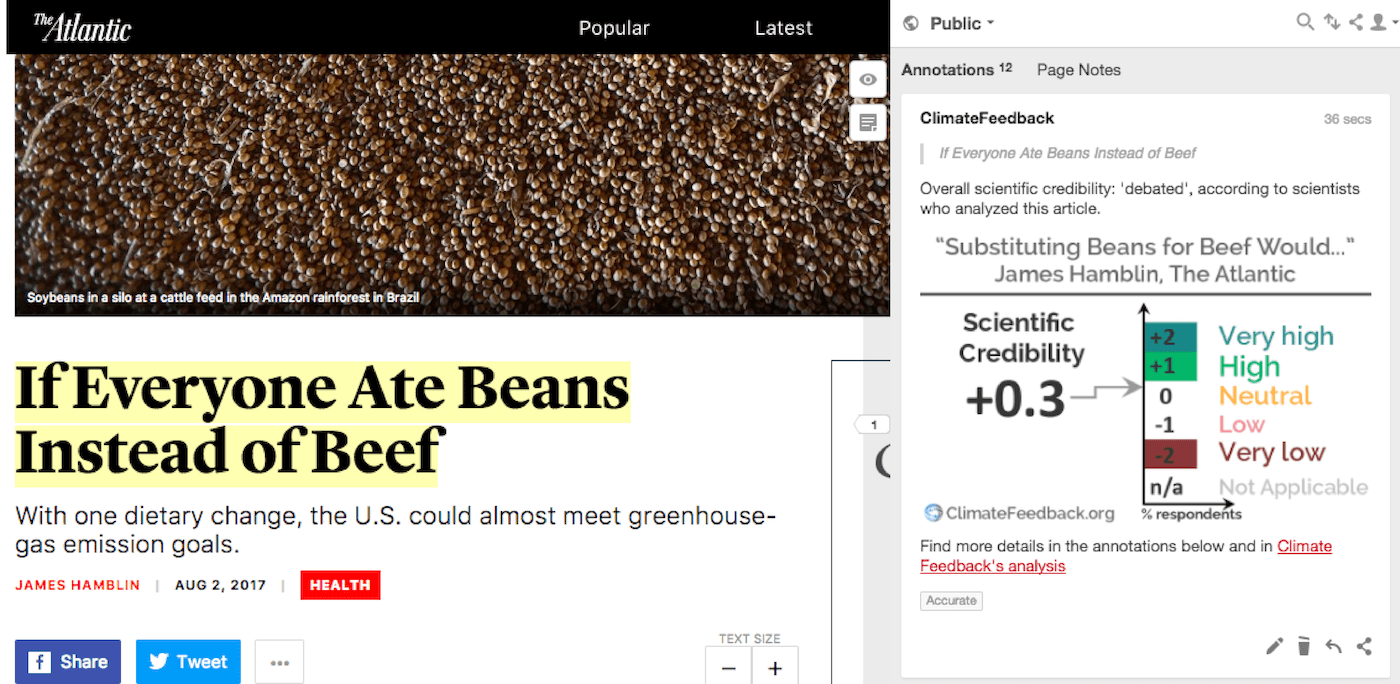
SCIENTISTS' FEEDBACK
SUMMARY
This Baronial 2017 commodity in The Atlantic covered a study of the greenhouse gas emissions that could be avoided if beefiness consumption was reduced in the United states. Beef is a particularly resource-intensive food, due in part to the fact that the conversion of plant foods into beef is much less efficient than obtaining calories and poly peptide from plants direct.
Scientists who reviewed the article were divided. While the commodity summarizes the main points of the paper effectively, some of the context provided is incomplete or potentially misleading. The carbon footprint of dietary choices is a complex topic that tin be easily oversimplified, making context disquisitional.
See all the scientists' annotations in context
This is part of a serial of reviews of 2017's most popular climate stories on social media.
Invitee COMMENTS
Gidon Eshel, Research professor, Bard College:
[Prof. Eshel was an author of the report described in this article.]
The story basically relays well the crux of the paper. Simple and to the signal, with non much to mutter about…
Alejandro Gonzalez, Research Scientist, National Research Council-Argentine republic (CONICET):
The article is strongly misleading the reader, who at start gets the impression that all beef eaten is from Brazil, which is totally imitation. Imports account for around 12% of beef consumed in the U.s., and Brazil contributes with simply v% of imports, while Australia, Canada, New Zealand and Mexico provide 86% of beefiness imported (run into ERS-USDA webpage). Thus, lowering beef consumption in the US is far from affecting Brazilian forests.
On the other mitt, it is not true that eliminating beefiness from diets will produce such reductions in GHG emissions. The author cites conclusions from a single work, simply in that location are hundreds of works published on diet and mitigation of climate modify. The consensus is that a well-planned diet change would lower greenhouse gas emissions, only none agree that banning a single product would bring any benefit. Not only beef but all creature products are much less efficient than plant-based ones, and meats other than beef also carry ecology burdens across greenhouse gases. The article is very bad—it mixes up sensational keynotes, climate-forest-Trump-beef-Brazil-efficiency-Paris agreement, in a rather random style, likely intending to stupor the reader and cause excitement.
REVIEWERS' OVERALL FEEDBACK
These comments are the overall opinion of scientists on the article, they are substantiated by their knowledge in the field and by the content of the assay in the annotations on the article.
Alexis Berg, Research Associate, Harvard University:
The article reports in a straightforward fashion on a scientific paper about the potential reductions in greenhouse gas emission in the U.s.a. resulting from substituting beans for beef. The article explains the issue (meat production diverts crops from humans to cattle) on a simple level. More caption and more context could have been provided, I call back, regarding individual-level and sectoral sources of greenhouse emissions.
Notes:
[1] See the rating guidelines used for article evaluations.
[2] Each evaluation is contained. Scientists' comments are all published at the same time.
ANNOTATIONS
The statements quoted below are from the article; comments and replies are from the reviewers.
"Recently Harwatt and a team of scientists from Oregon State University, Bard College, and Colina Linda University calculated just what would happen if every American made ane dietary modify: substituting beans for beefiness."
Ana Bastos, Group Leader, Max Planck Institute for Biogeochemistry:
Beans have a carbon footprint between i-two kilograms of CO2 equivalent per kilogram, while values for beef range nine-129*. Since they differ in their energy and protein content, the authors of this study calculated separately the COii emissions resulting from replacing beans for beef for the same amount of free energy or proteins.
- Nijdamet et al (2012) The price of protein: Review of country use and carbon footprints from life cycle assessments of fauna food products and their substitutes, Nutrient Policy
"and even if people kept eating chicken and pork and eggs and cheese"
Alexis Berg, Research Associate, Harvard University:
A significant share of beef supply in the US comes from dairy cows (around 20% I recollect)—typically, as processed meat. And so switching beef for beans would likely impact the dairy sector as well.
"this one dietary change could achieve somewhere between 46 and 74 pct of the reductions needed to meet the target."
Alexis Berg, Research Associate, Harvard University:
That target should be described explicitly: -17% of greenhouse gas emissions compared to 2005 levels, by 2020. Given that emissions have been decreasing since 2005 (in no uncertain part because of the economical crisis of 2008)—which was already obvious when the Obama Administration made that pledge in 2009—what is needed is a farther 7% decrease compared to 2013 levels (co-ordinate to the authors of the paper cited in this commodity).
Note, this target is much less than the Paris Agreement: -27% by 2025.
"more so than downsizing i's car, or beingness vigilant most turning off low-cal bulbs, and certainly more than quitting showering."
Alexis Berg, Research Associate, Harvard University:
To be honest, the action listed here are rather little. I don't recall anybody reasonable is advocating for people to stop showering all together to conserve energy (that's non even the rationale of the article linked to).
Perhaps a more relevant comparison would be against individual carbon emissions from flight, which for people who fly a lot tin can represent a large function of their footprint.
"Which is to say that these beans volition be eaten past cows, and the cows will convert the beans to meat, and the humans will eat the meat. In the process, the cows volition emit much greenhouse gas, and they will consume far more calories in beans than they volition yield in meat, meaning far more clearcutting of forests to subcontract cattle feed than would exist necessary if the beans higher up were merely eaten by people."
Alexis Berg, Research Acquaintance, Harvard Academy:
Information technology would exist nice to explain the source of these emissions (methane production, manure management, etc.).
Ana Bastos, Grouping Leader, Max Planck Constitute for Biogeochemistry:
Even compared to other meat products, beef has additionally lower meat yield, i.e. the weight of meat produced per kg of live weight*1, and lower energy efficiency (lower energy output per free energy input*two).
- 1- Nijdamet et al (2012) The cost of poly peptide: Review of land use and carbon footprints from life cycle assessments of animal food products and their substitutes, Food Policy
- 2- Eshel and Martin (2005) Diet, Energy, and Global Warming, Earth Interactions
"Even more than, 26 percent of the ice-gratuitous terrestrial surface of Earth is used for grazing livestock."
Alexis Berg, Research Associate, Harvard University:
Note that some of this corresponds to marginal lands that wouldn't necessarily exist well suitable for crops, and it could exist argued that over such land it would make sense to raise cattle.
"focusing on where efforts will have the highest yield"
Alexis Berg, Research Acquaintance, Harvard University:
While there is no doubtfulness that non eating beef would reduce greenhouse gas emissions and may be one the single most efficient individual deportment (forth with less flying/driving), information technology'southward worth keeping in mind that, according to the EPA, the agronomical sector represents simply 9% of US greenhouse gas emissions. (That number is higher world wide—around ~twenty%—presumably because other source of emissions are also very loftier in the U.s.…)
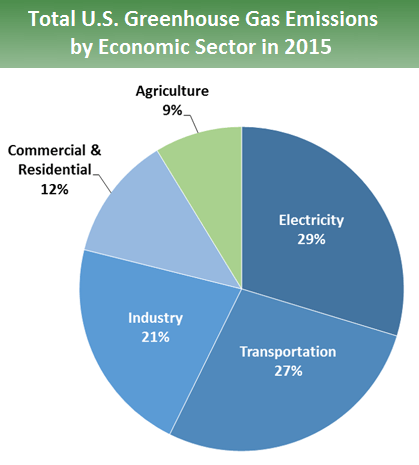
Source
burdickalwastood56.blogspot.com
Source: https://climatefeedback.org/evaluation/atlantic-climate-implications-reduced-beef-consumption-provide-clearer-context-james-hamblin/
0 Response to "The Atlantic Beans Instead of Beef"
Postar um comentário